Project Photos
Inspired by this project? We'd love to help with yours.
Stainless steel wire and rope balustrade systems — a sleek, cost-effective alternative to glass for gardens, terraces, and staircases.
Wire and rope balustrades use horizontal or vertical runs of tensioned stainless steel cable stretched between posts — rather than glass panels. They are not a glass product. The aesthetic is distinct from glass: more minimal, more industrial, or with a coastal or contemporary rural feel. If you want the absolute maximum transparency, glass remains the cleaner choice. But if you are drawn to a more structural, cable-and-post aesthetic, wire rope systems offer a high-quality, durable, and often more economical alternative.
Wire rope balustrades have become very popular over the last decade — particularly for garden terraces and contemporary self-build homes, where the industrial-meets-minimalist look complements timber cladding, concrete, and large-format stone perfectly. They maintain outward views effectively and, like glass, require far less maintenance than traditional timber balusters.
All our wire rope systems use A2 stainless steel cable and components, surface-mounted posts, and tensioned end fittings. We design and install within a 50-mile radius of Mansfield — and supply wire rope systems UK-wide.
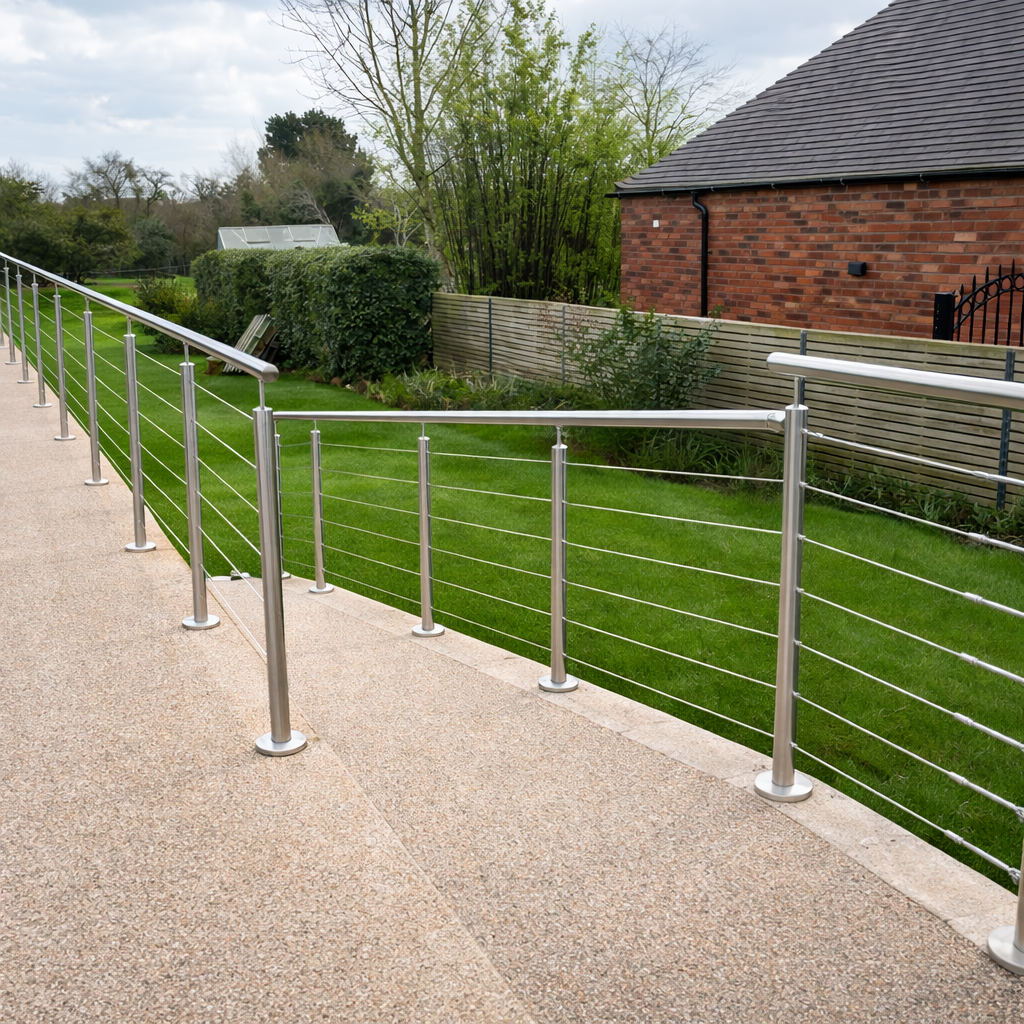
The most widely used wire balustrade configuration. Multiple horizontal runs of stainless steel wire are tensioned between posts, with a top handrail above. We offer two wire diameters: 3mm for lighter residential applications and 6mm for longer spans or heavier-duty use. Cables are spaced at equal intervals — typically 100mm centres or less to comply with guarding regulations.
The result is an open, airy barrier that maintains sightlines across gardens, terraces, and external decking areas. Viewed straight-on, the cables are visible; viewed at a slight angle, they almost disappear — giving a very open feel in practice. Horizontal systems are popular for long garden runs and anywhere a panoramic view is a priority.
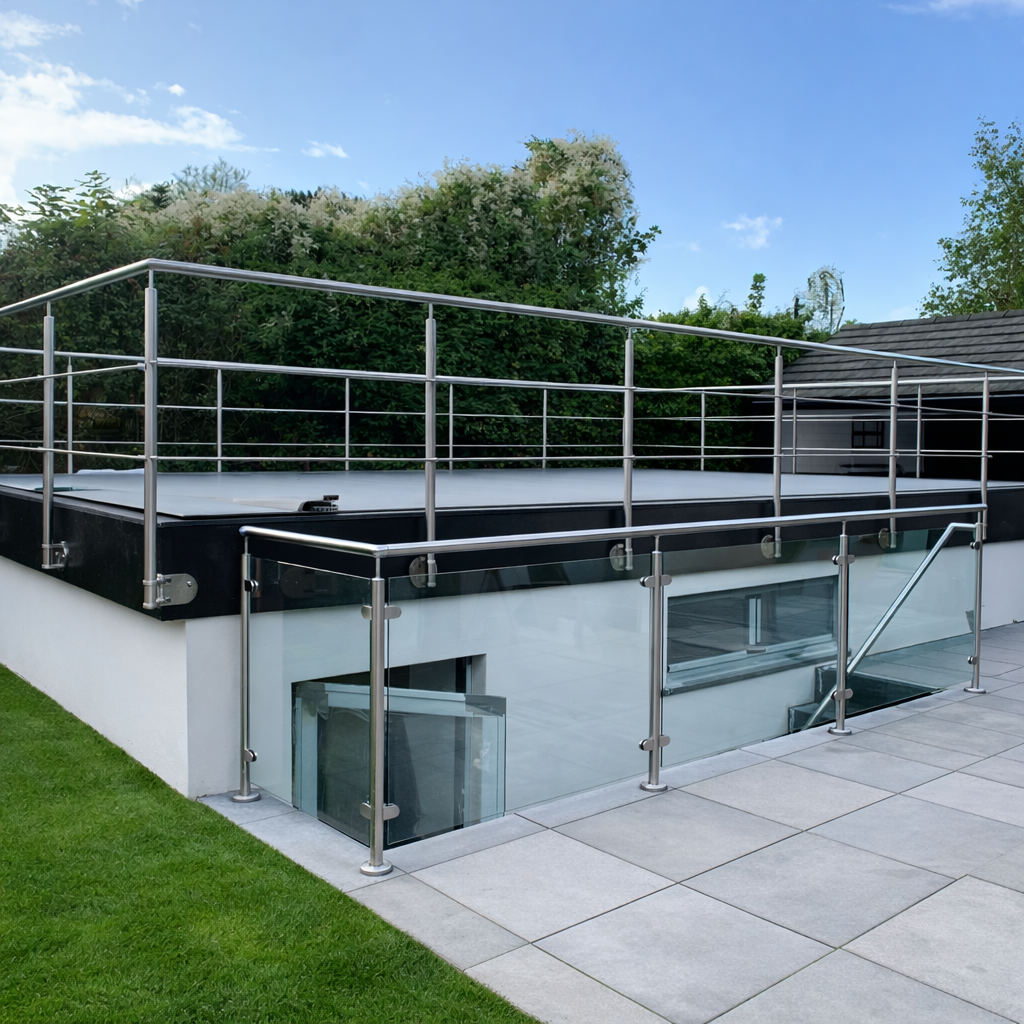
The 8mm stainless steel bar system uses solid round bar infill in place of wire cable. Bars are fixed between posts — either horizontally or vertically — giving a more substantial, architectural appearance than wire while remaining considerably more open than a glass panel.
The solid bar profile is more rigid than wire and does not require tensioning, making it a particularly clean and maintenance-free solution. It suits contemporary and industrial aesthetics well, and is a popular choice for mezzanine edges, external staircases, and raised terraces where a structured look is preferred over the near-invisible appearance of fine wire.
Wire rope balustrades are generally lower in cost than frameless glass systems, particularly on longer runs where the glass panel cost adds up quickly. They are also lighter in weight — which can be a factor on raised timber decking structures with limited loading capacity.
Cables are straightforward to source and replace individually if ever needed (though this is rarely required in practice), whereas a replacement glass panel requires a new bespoke cut and often a specialist fitting visit. For very long exposed runs — particularly in coastal or high-wind locations — wire also offers less wind resistance than a continuous glass panel, which reduces loading on posts and fixings.
The aesthetic difference is significant. Glass gives the cleanest, most invisible barrier — the view is entirely uninterrupted. Wire has a more defined, structural look — you are aware of the cable runs, and the overall appearance is more industrial or architectural. Neither is better in objective terms; it is a matter of which look is right for your property and personal taste.
If you want the cleanest, most transparent barrier, our frameless glass balustrade pages have full details. If the wire rope aesthetic appeals — or if budget or weight are factors — we are happy to design and install a wire rope system to suit your project.
If you would like the cleaner, fully transparent look that only glass provides, our frameless and framed glass balustrade pages have full details on every system we offer.
Get a free, no-obligation quotation for your wire rope balustrade project. Call us, email, or use our contact form and we will respond promptly with advice and a competitive price.
Inspired by this project? We'd love to help with yours.