Frameless Glass Staircases
No posts. No spindles. Just glass. Two distinct systems — one for existing timber staircases, one for floating and cantilevered step installations — both achieving a completely clean, unobstructed finish.
Two Ways to Achieve a Truly Frameless Finish
A frameless glass staircase removes everything you'd normally associate with a balustrade — no newel posts, no spindles, no visible rail fixings. What remains is a continuous run of structural glass that defines the edge of the staircase without interrupting the view through it. The approach we use depends on your staircase type: a renovation on an existing timber stringer, or a new installation on floating or cantilevered steps.
Both systems use 12mm or 15mm toughened laminated safety glass and are designed to comply with UK Building Regulations. The difference is in how the glass is fixed and what the staircase structure looks like underneath.
Glass Fixed to the Stringer Face
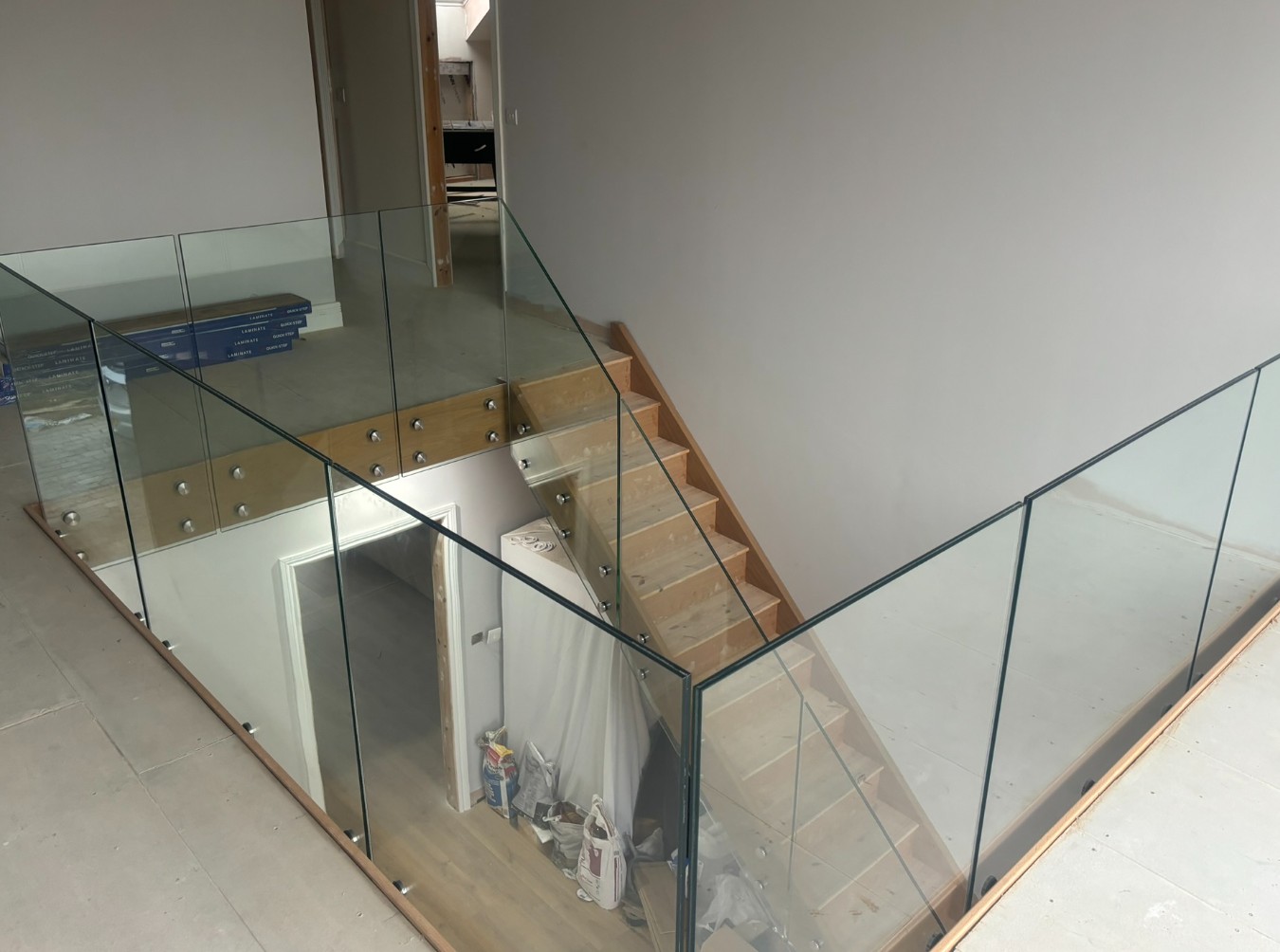
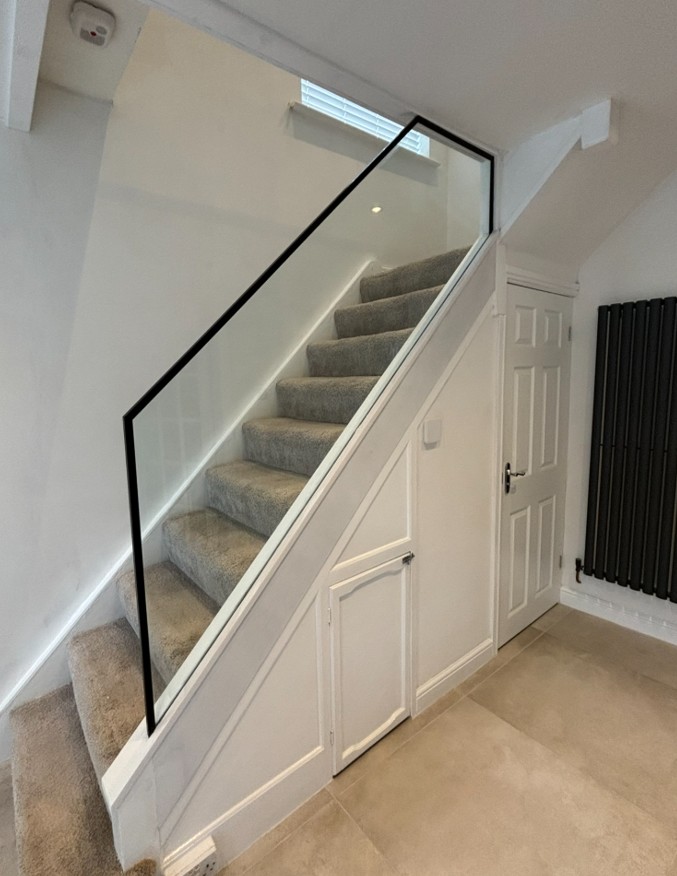
This is the frameless option for existing timber staircases where a full rebuild isn't needed or wanted. We fix structural glass panels directly to the face of the existing stringer using countersunk fixings or standoff brackets — fixings that pass through pre-drilled holes in the glass and anchor into the timber behind.
Once the glass is in place, we clad the stringer face and the base of the glass run with a matching timber profile — oak, painted MDF, or whatever suits the interior. This hides every fixing and creates a completely clean, cohesive finish. From the side, you see timber stringer, seamless glass, handrail. Nothing else. The staircase looks like it was always built this way.
- Glass fixed to existing stringer face with countersunk bolts or standoff brackets
- All fixings can be concealed behind stringer and base cladding
- New handrail fitted above — oak, painted timber, or stainless steel if needed
- Toughened or laminated safety glass
How the Cladding Works
The countersunk fixings that hold the glass to the stringer are strong but visible if left exposed. The cladding is what turns a technically frameless system into a visually seamless one. We fit a timber fascia board to the face of the stringer that runs the full length of the staircase — this covers the fixing heads at the base of each glass panel. A separate base trim profile runs along the bottom edge of the glass, bridging the gap between glass and stringer and giving the joint a finished appearance.
The cladding is fitted in the same material and finish as the rest of the balustrade — if you have oak stringers or treads, the cladding is oak. If the staircase is painted white, the cladding is painted to match. The result is a staircase where the glass appears to float above a continuous timber base with nothing visible holding it.
- Stringer fascia board conceals countersunk fixing heads
- Base trim profile finishes the glass-to-stringer joint
- Matched in oak, painted timber, or other finish
- Clean, cohesive result — no visible hardware
Standoff Buttons on Floating & Cantilevered Steps
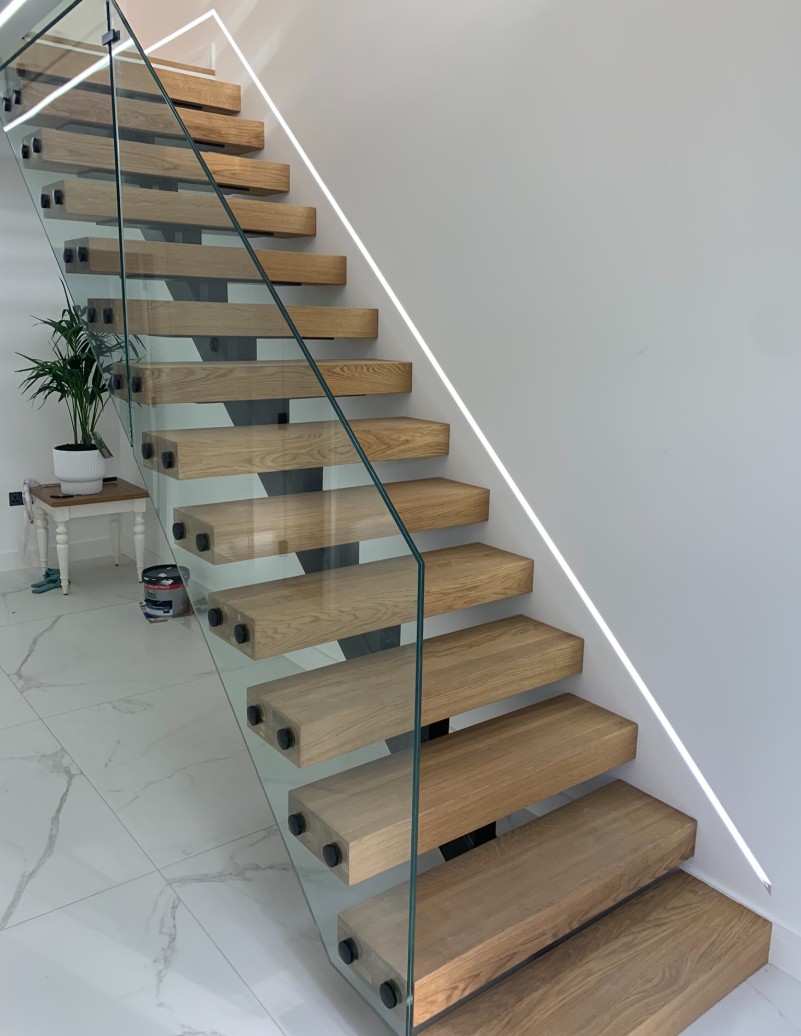
Where a staircase has floating or cantilevered steps — typically on a new-build steel-based structure — there is no stringer to fix to. Instead, we use polished or brushed stainless steel standoff buttons fixed directly to the face or underside of each step. The buttons pass through pre-drilled holes in the glass panels and anchor into the step structure behind, holding each panel firmly in position.
This is a common specification on contemporary open-tread staircases where the steps are supported by a central steel spine or wall-mounted brackets. The standoff buttons are designed to be seen — they are the only visual element of the fixing system, and in polished or brushed stainless they become a considered design detail rather than a compromise. The glass runs continuously from the bottom step to the landing, with no posts breaking the line.
- Stainless steel standoff buttons fixed to each step face
- Glass panels pre-drilled to accept button fixings
- Brushed or polished stainless steel finish
- Suits floating, cantilevered, and open-tread step designs
- Commonly specified on steel-framed new-build staircases
- 17.5mm or 21.5mm toughend and laminated safety glass
Standoff Button Fixings
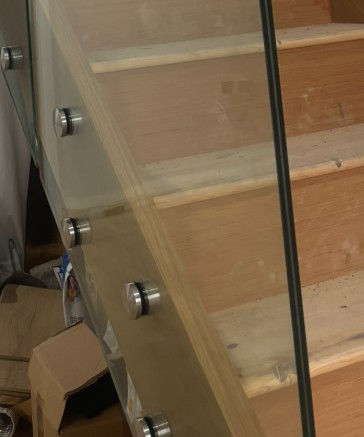
A standoff button consists of a threaded barrel that anchors into the step structure and a cap fitting that sits against the face of the glass panel. The glass is pre-drilled with a countersunk hole at each fixing point — typically two buttons per panel, one at the top and one at the bottom. The cap is tightened against the glass face, compressing a neoprene gasket that protects the glass edge from contact stress.
The buttons are visible — they project slightly from the glass face — but the profile is minimal and the stainless finish is intentionally decorative. On a well-detailed steel staircase, the standoff buttons complement rather than detract from the overall aesthetic. We can supply buttons in brushed, polished, or satin stainless to match existing metalwork on the staircase structure.
- Threaded inserts followed by steel bolts for solid fixture
- Neoprene gasket protects glass at fixture point
- Brushed, polished, or powder coated finish
- 6-8 standoffs per panel — bottom only fixing
- Glass pre-drilled to exact fixing positions
Glass Specifications for Frameless Staircases
Frameless staircase glass must perform structurally without a frame to contain fragments. All specifications below use toughened glass as a minimum; laminated options bond two toughened layers to a PVB interlayer so that if the panel is ever broken, the fragments stay in place rather than falling.
15mm Toughened
Single-layer toughened glass at 15mm. A robust specification for stringer-fixed renovation installations where the stringer provides continuous edge support along the full length of the panel.
17.5mm Toughened & Laminated
Two layers of toughened glass bonded to a PVB interlayer. The standard laminated specification for frameless staircase panels — combines structural rigidity with retained-fragment safety in the event of breakage.
21.5mm Toughened & Laminated
Heavy-duty laminated specification for longer spans, taller panels, or standoff-button systems on floating and cantilevered steps where each panel is point-fixed rather than continuously supported.
Satin & Tint Options
All thicknesses are available in satin or tinted finishes. Satin gives a soft, diffused appearance while retaining the structural properties of the glass. Tints range from subtle grey or bronze through to bolder coloured laminates to complement the staircase design.
Frameless Glass Staircase Costs
Frameless glass staircase costs depend on the number of steps, panel dimensions, glass specification, and fixing system. The figures below are typical ranges — send us a photo and measurements for a more accurate ballpark.
Stringer-Fixed Renovation
Glass fixed to existing stringer face with countersunk bolts, stringer and base cladding, new handrail. Balustrade renovation on existing staircase.
approx £2,000 – £3,500
Standoff Button Installation
Frameless glass panels on floating or cantilevered steps with stainless steel standoff button fixings. New installation on existing or new step structure.
approx £3,500 – £5,500
Premium & Commercial
Larger staircases, 21.5mm low-iron laminate, bespoke handrail design, or commercial specification with structural calculations and Building Control sign-off.
from £5,500+
All prices include supply and installation. For a full breakdown see our costs guide, or contact us for a no-obligation quotation.
Related Services & Guides
Ready to Start Your Frameless Glass Staircase Project?
Get in touch for a free, no-obligation quotation. We cover Nottinghamshire, Derbyshire, South Yorkshire, and the wider East Midlands.