Acoustic Glass Partitions: Meeting Rooms, Offices & Studios
Double-glazed and acoustic laminate glass partition systems designed for genuine sound separation: meeting rooms, boardrooms, HR offices, and home studios. Rw 38–42 dB with correct door specification.
When You Need More Than General Noise Reduction
A standard single-glazed glass partition (10mm toughened in an aluminium frame) reduces sound by approximately Rw 28–32 dB. That is enough to make an adjacent space noticeably quieter and to reduce the clarity of speech, but it is not enough to prevent conversations from being understood through the partition. For most open-plan office zoning, it is fine. For a meeting room where confidential discussions happen, it is not.
Acoustic glass partitions use double-glazed units or acoustic laminate glass to push performance to Rw 38–42 dB, the threshold where normal conversation becomes difficult to follow through the partition. But the glass specification is only part of the equation. The door and its perimeter seals are equally critical: sound passes through the path of least resistance, and a poorly sealed door undoes a well-specified glass panel.
Frameless vs Framed: Why It Matters for Acoustic Performance
The term "frameless" in glass partitions describes how a system looks, not how it is constructed. Most partition systems, including minimal-profile designs, use discreet head and base channels for structural stability. What this means in acoustic terms is that the real variable is almost never "frameless vs framed panels"; it is the door.
Framed Door: Better Acoustic
A door leaf within an aluminium frame, hinged to the partition post. The frame accepts compression acoustic seals on all four sides of the door opening. When the door closes, these seals engage and eliminate the gap, the primary route for sound to bypass even the best glass specification. The standard choice for meeting rooms and any space where speech privacy matters.
Frameless Pivot Door: Lower Acoustic
A 12mm+ glass leaf hung on a floor pivot: no aluminium frame around the door. Clean, minimal appearance; can open in both directions. The trade-off is acoustic: without a surrounding frame, compression seals cannot be fitted effectively on all sides, and the gap around the pivot leaf is harder to close. Not the right choice where acoustic performance is specified.
For acoustic applications (any Rw target above Rw 34 dB), we specify aluminium-framed partitions with framed doors and compression perimeter seals. The glass specification sets the ceiling; the door and seals determine how close you get to it.
Glass Partition Acoustic Performance: What the Numbers Mean
Rw (weighted sound reduction index) is measured in decibels. Each 10 dB increase roughly halves the perceived loudness. The differences between the specifications below are noticeable in real use, not just on paper.
Rw ~28–32 dB: Standard Single-Glazed
10mm toughened glass in aluminium frame. Noticeably quieter on the other side of the partition; speech is audible but less clear. Suitable for open-plan office zoning, department separation, and reception screens. Not suitable where conversation privacy is required.
Rw ~34–36 dB: Acoustic Laminate
10.8mm or similar toughened laminate with PVB acoustic interlayer. The interlayer damps the resonance of the glass pane, improving performance without a double-glazed cavity. A useful middle-ground for meeting rooms on a budget where full speech confidentiality is not essential.
Rw ~38–42 dB: Double-Glazed Framed
Two toughened panes (typically 6mm+6mm or 4mm+acoustic+4mm) with an air or argon-filled cavity, in an aluminium frame. Normal conversation becomes difficult to follow through the partition. The standard specification for meeting rooms, HR offices, and boardrooms. Requires acoustic door seals to achieve the rated performance.
Rw 42 dB+: Enhanced Specification
Wider cavity, heavier glass panes, or specialist acoustic glazing units. Used for recording studios, music practice rooms, legal consultation rooms, and any application where speech confidentiality is critical. Requires a full acoustic door set, not just perimeter seals on a standard door.
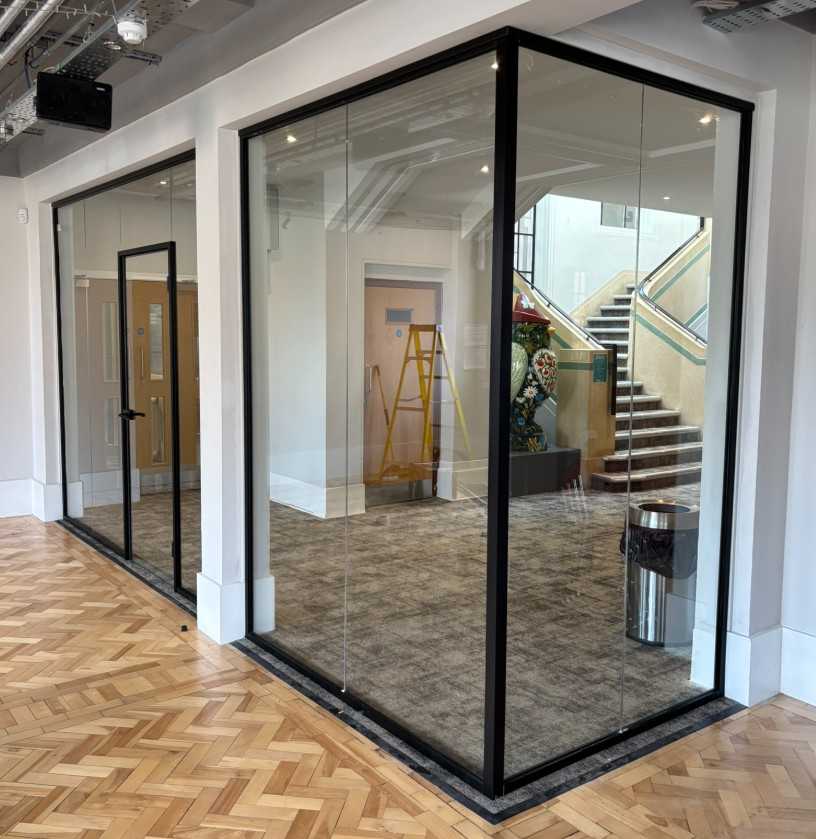
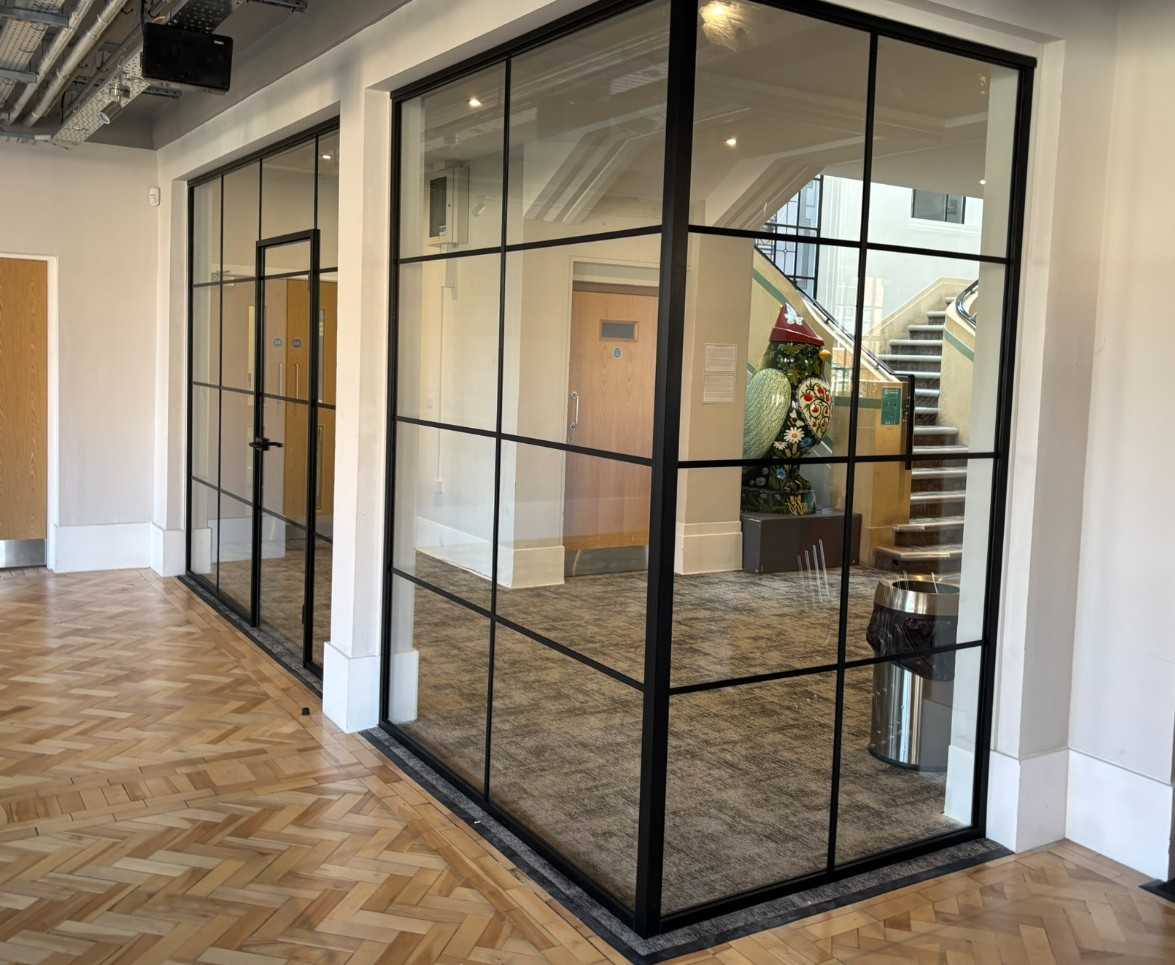
Double-Glazed Aluminium-Framed Partitions
The standard acoustic specification for commercial meeting rooms. Two toughened glass panes are separated by a spacer bar filled with silica desiccant and sealed at the perimeter, the same construction as a double-glazed window unit. The cavity between the panes (typically 12–20mm) is filled with air or argon gas. The unit sits in a slightly deeper aluminium frame profile than a single-glazed system.
Acoustic performance depends on the pane thicknesses, cavity width, and whether an acoustic interlayer is used in one of the panes. A standard 4+12+4 unit (4mm glass, 12mm cavity, 4mm glass) achieves approximately Rw 38 dB. Using a 6mm pane on one or both sides, or incorporating a PVB acoustic layer, pushes performance higher. We specify the unit based on the required Rw and the frame profile depth available.
- Double-glazed unit: two toughened panes with sealed cavity
- Air or argon fill: argon marginally better acoustic performance
- Typical unit: 4+12+4 to 6+16+6 depending on spec
- Aluminium frame accommodates the unit depth: 24–28mm typical
- Demountable system: full disassembly possible
- Powder coated to any RAL: matches single-glazed partition visually
Why the Door Matters as Much as the Glass
Glass partition acoustic performance ratings are for the glass and frame assembly tested in a laboratory. In real installations, the weakest acoustic link is almost always the door, specifically the gap around the door leaf when it is closed.
A 3mm gap around a door frame, the kind that exists in a standard door set without acoustic seals, can reduce the effective Rw of the installation by 10–15 dB. In other words, a double-glazed partition rated at Rw 40 dB installed with a standard door and no seals may perform at Rw 28–30 dB in practice. The glass specification is wasted if the door is not treated with the same care.
We address this with acoustic perimeter seals on the door frame: compression seals that engage automatically when the door closes, eliminating the gap at head, jambs, and threshold. An overhead closer ensures the door closes fully every time. On the highest-spec installations, an automatic drop seal is used at the threshold to avoid a fixed step-over.
- Acoustic compression seals on all four sides of the door frame
- Overhead closer: standard, delayed-action, or hold-open
- Automatic drop seal at threshold (high-spec installations)
- Seals should be inspected annually and replaced when compressed
Where Acoustic Glass Partitions Are Specified
The acoustic specification required varies by application. Here is a guide to typical requirements.
Meeting Rooms
Standard meeting rooms: Rw 38–40 dB. Double-glazed 4+12+4 or 4+16+4 units with acoustic door seals. Conversations not easily overheard from outside. The most common commercial acoustic partition specification.
Boardrooms & HR Offices
Rw 40–42 dB. Heavier glass units (6+16+6 or acoustic interlayer) with full acoustic door set. Speech confidentiality for sensitive discussions. Manifestation required for Building Regulations compliance.
Home Studios & Music Rooms
Rw 42 dB+. Enhanced specification with wider cavity, heavier panes, and full acoustic door. Background noise isolation for recording and practice. Acoustic treatment of the room itself is also usually required; the partition is one component of a wider acoustic scheme.
Home Offices
Acoustic laminate single-glazed (Rw ~34–36 dB) is often sufficient for a home office enclosed within an open-plan space. Better than standard toughened glass; less expensive and less complex than double-glazed. Suitable where the goal is focus and reduced distraction rather than full speech privacy.
Related Services & Guides
Specify the Right Acoustic Performance for Your Project
Tell us the application, the required Rw rating, and the room dimensions. We will specify the correct glass, frame, and door system and provide a no-obligation quotation. East Midlands coverage, no subcontractors.