Glass Types Explained
A plain-English guide to the glass types we use in balustrades, staircases, and partitions — so you can choose with confidence.
Why Glass Type Matters in Balustrades
All glass used in balustrades, Juliet balconies, and guarding applications must be safety glass. This is a legal requirement under Approved Document N of the Building Regulations and BS 6262. We only ever supply toughened or laminated glass in safety barrier applications — no standard float glass, ever.
Beyond standard clear glass, we can supply grey tinted, satin, reeded, coloured interlayer, and specialist laminated options — all in toughened or laminated safety glass specification. The guide below explains the core glass types and thicknesses used across our systems.
Toughened (Tempered) Glass
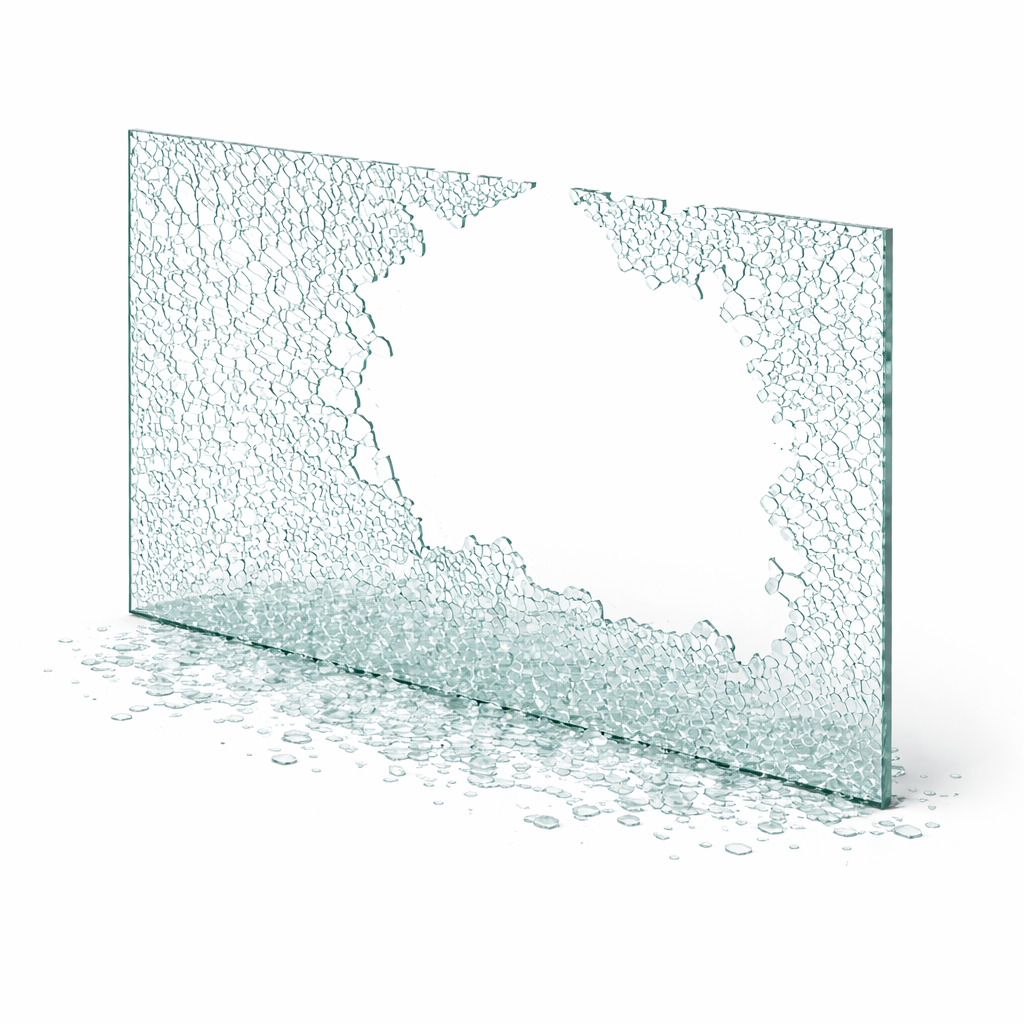
Toughened glass is produced by heating standard float glass to around 620°C and then rapidly cooling it. This thermal process puts the outer surfaces into compression and the inner core into tension, making the finished pane approximately four times stronger than untreated glass of the same thickness.
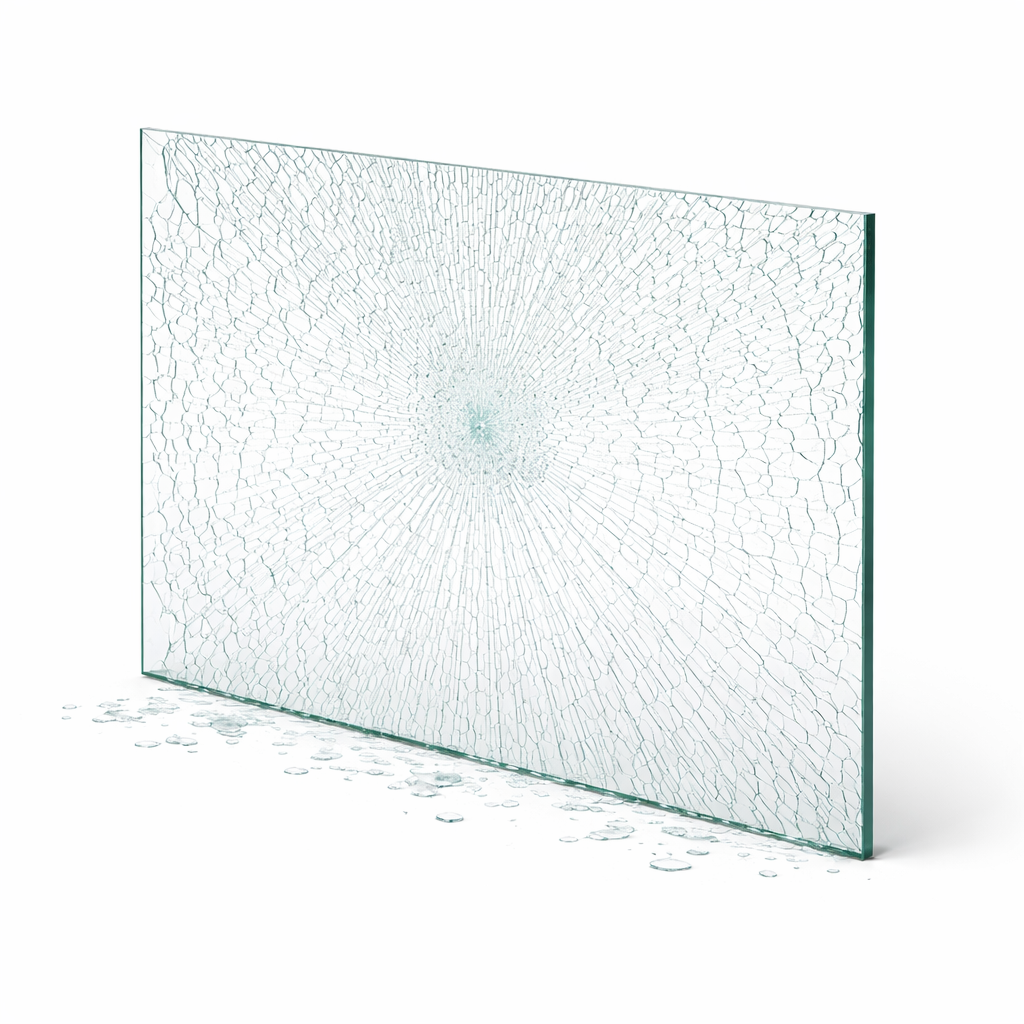
If toughened glass is broken — which takes a significant impact — it shatters into small, rounded fragments rather than long, sharp shards. This characteristic is what qualifies it as safety glass.
- Approx. 4× stronger than standard float glass
- Breaks into small blunt fragments — no sharp shards
- Compliant with BS EN 12150
- Available in 8mm, 10mm, 12mm, and 15mm thicknesses
- Cost-effective choice for most residential installations
Toughened glass is used in framed post & rail systems, semi-frameless systems, and frameless channel systems where laminated is not a regulatory requirement. Because it is thermally processed as a finished pane, holes, notches, and cut-outs must be specified before toughening — they cannot be added afterwards.
Laminated Glass
Laminated glass is made from two or more glass plies permanently bonded together with an EVA (ethylene-vinyl acetate) interlayer. EVA offers superior clarity, moisture resistance, and long-term adhesion compared to PVB — and is the interlayer we specify across all our laminated glass. If a laminated panel is broken, the interlayer holds the fragments in place — the glass cracks but stays within the frame or channel rather than falling away.
This retained-glass-on-break characteristic is essential in elevated applications. If a toughened-only panel were to fail at height, the fragments would drop. Laminated glass stays put. This is why it is mandatory for Juliet balconies, exposed elevated balconies, and pool fencing.
- Glass stays in fixings if broken — no falling fragments
- Compliant with BS EN 14449
- Required on all Juliet balconies and elevated external use
- Required for pool fencing applications
- Standard thicknesses: 13.5mm (2×6.4mm), 17.5mm (2×8mm), 21.5mm (2×10mm)
Laminated glass is slightly more expensive than toughened glass of comparable thickness and is also slightly heavier. For most residential elevated applications we specify 17.5mm laminated as a minimum.
Low Iron (Extra-Clear / Optiwhite) Glass
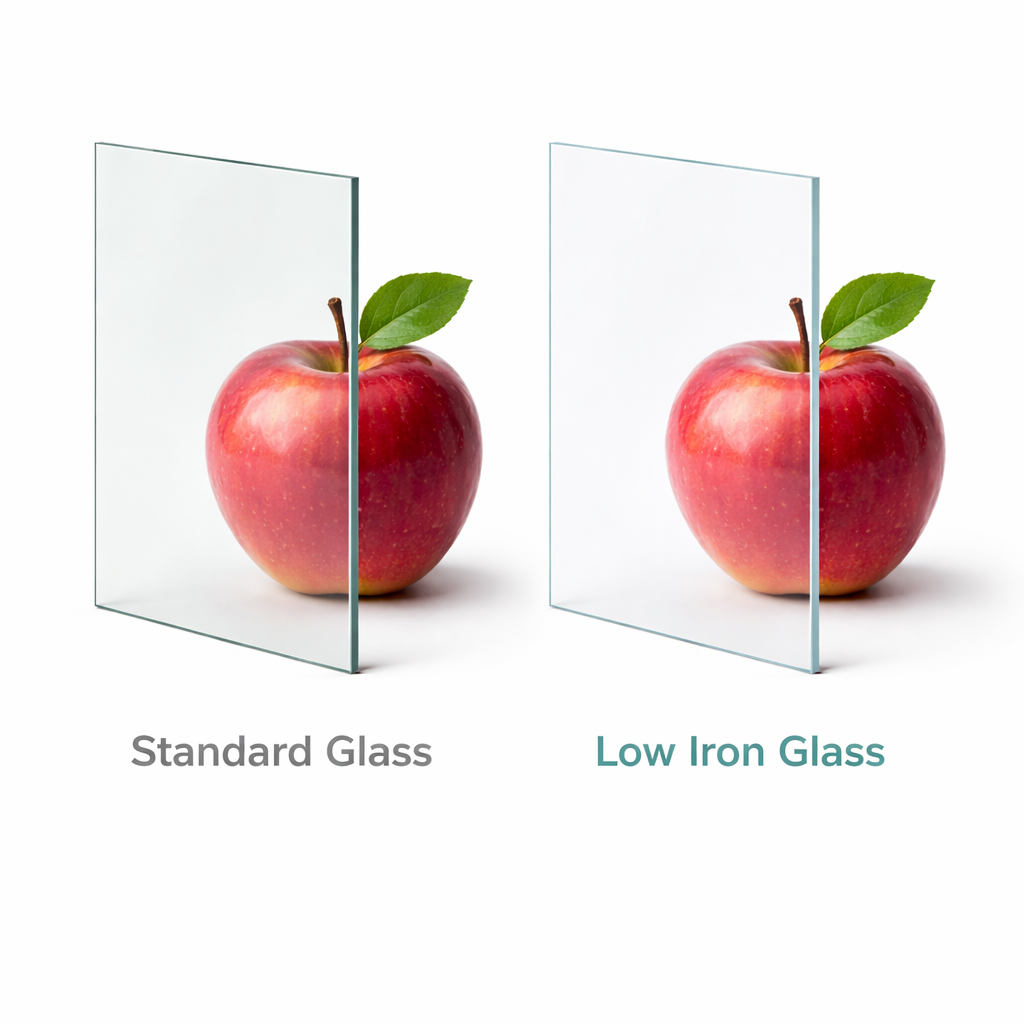
Standard clear glass contains a small amount of iron oxide in its composition. This gives it a faint green tint, most visible when you look at the edge of a panel or view it against a white background. For most applications this tint is barely noticeable, but in premium installations — particularly against white or light-coloured walls — it can be aesthetically undesirable.
Low iron glass (sold under trade names such as Optiwhite, Starphire, and Diamant) has the iron content significantly reduced, resulting in a truly colourless, crystal-clear panel with no green cast whatsoever. Light transmission is marginally higher than standard glass.
- No green tint — truly colourless appearance
- Highly recommended for frameless frameless installations on light-coloured elevations
- Ideal for indoor glass partitions and wine rooms where clarity is paramount
- Marginally higher light transmission than standard clear
- More expensive than standard toughened or laminated glass
Low iron glass is available in both toughened and laminated specifications. If colour accuracy matters to your project, ask us about upgrading to low iron at the quotation stage.
Recommended Glass Thickness by System
The table below shows our standard glass specifications for each balustrade system. Actual specification is always confirmed during the survey, as span, loading, exposure, and height all influence the final selection.
| System / Application | Recommended Thickness | Glass Type |
|---|---|---|
| Post & rail framed (indoor) | 10mm | Toughened |
| Post & rail framed (outdoor) | 10mm | Toughened |
| Semi-frameless | 10mm or 11.5mm | Toughened or Laminated |
| Frameless channel (residential) | 17.5mm | Laminated |
| Frameless channel (elevated / exposed) | 17.5mm | Laminated (minimum) |
| Frameless spigot | 17.5mm or 21.5mm | Laminated |
| Juliet balcony | 17.5mm or 21.5mm | Laminated |
| Pool fencing | 17.5mm | Laminated (minimum) |
| Staircase panels (grooved channel) | 8–10mm | Toughened |
| Staircase panels (clamped / standoff) | 10mm | Toughened |
More Than Just Clear Glass
While clear toughened and laminated glass is the most common choice, we can supply a range of glass types and finishes to suit your project. Options include:
- Clear toughened or laminated — the standard for most installations
- Grey tinted — a subtle tint that can complement darker frames and contemporary schemes
- Satin / acid-etched — a frosted finish for privacy without blocking light
- Reeded — textured patterned glass for decorative applications
- Coloured interlayer — laminated glass with a coloured EVA interlayer for a bold, bespoke look
- Specialist interlayers — including acoustic, UV-filtering, and privacy interlayers on request
- Low iron (Optiwhite) — crystal clear with no green tint, ideal for premium frameless installations
If you have a specific requirement, mention it at the quotation stage and we will advise on what is achievable within your system type and budget.
BS EN 12150 — Toughened Glass
The British and European Standard governing thermally toughened soda lime silicate safety glass. Sets requirements for dimensional tolerances, fragmentation behaviour, and bow and warp limits. All toughened glass we supply meets this standard.
BS EN 14449 — Laminated Glass
The British and European Standard covering laminated safety glass and laminated glass. Specifies the test methods for interlayer adhesion, resistance to humidity, and retained glass performance after breakage. All laminated glass we supply meets this standard.
Ready to Discuss Your Glass Balustrade?
We will advise on the correct glass type and thickness for your application, provide a detailed specification, and give you a fast, no-obligation quotation.